Plaster powder, a key material in construction and interior decoration, often requires efficient and reliable transportation methods to ensure quality and consistency. Pneumatic conveying technology has emerged as a preferred solution for handling plaster powder due to its ability to transport materials in a dust-free environment, enhance product purity, and improve operational efficiency. This article provides an in-depth exploration of the working principles of pneumatic conveying systems for plaster powder, along with an overview of their classification and practical applications, all presented by Shandong HeadPowder Engineering Co., Ltd., a leading provider of specialized material handling solutions.
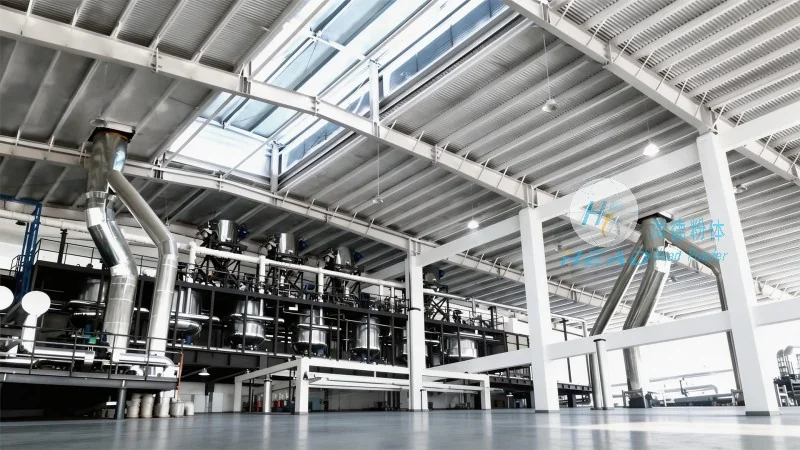
Working Principle of Plaster Powder Pneumatic Conveying
The core of pneumatic conveying for plaster powder lies in the use of air as the medium to transport the powder particles. The process typically involves creating a pressure differential between the conveying line and the ambient environment. There are two primary modes of operation: positive pressure and negative pressure systems. In positive pressure systems, air is blown into the conveying line, pushing the powder particles through the pipeline. Conversely, negative pressure systems create a vacuum that draws the powder into the line. The selection of a system depends on factors such as the material's properties, the distance to be conveyed, and the required flow rate. The working principle also involves the use of components like feeders, conveyors, and separation devices to ensure smooth and efficient material transport. For example, in a positive pressure system, a rotary valve or a screw feeder can be used to introduce the plaster powder into the conveying line, while a venturi or a cyclone separator can be employed to separate the powder from the air at the discharge end.
Classification of Pneumatic Conveying Systems for Plaster Powder
Pneumatic conveying systems for plaster powder can be classified based on several criteria, including the pressure differential, the type of air flow, and the application requirements. The most common classifications are positive pressure systems and negative pressure systems. Positive pressure systems are generally more suitable for long-distance and high-volume conveying, as they can maintain consistent pressure and flow rates. These systems are often used in industrial settings where large quantities of plaster powder need to be transported from a central storage to multiple processing points. Negative pressure systems, on the other hand, are ideal for short-distance conveying and applications where dust control is critical. They are commonly used in environments where minimizing dust emissions is a priority, such as in food processing or pharmaceutical industries, though in the case of plaster powder, they are more often used for smaller-scale operations or for conveying to nearby mixing or packaging units.
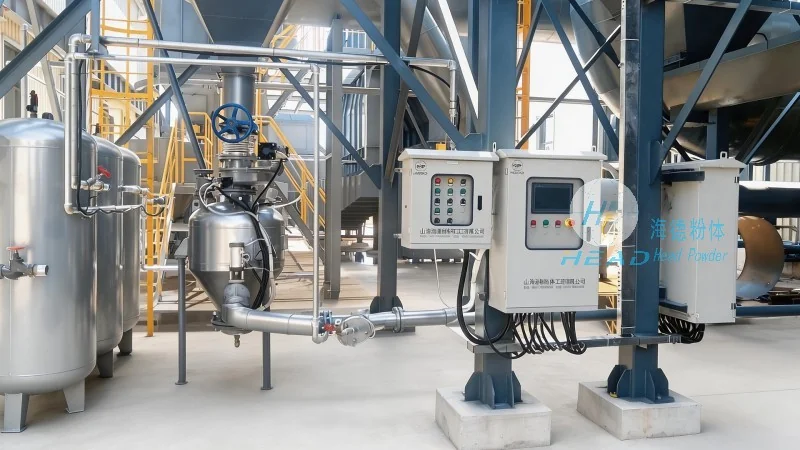
Key Components and Their Functions in Plaster Powder Pneumatic Conveying
Effective pneumatic conveying of plaster powder relies on a series of interconnected components, each playing a crucial role in the overall system. The primary components include the feeder, the conveying line, the air source, and the separation equipment. The feeder is responsible for accurately metering and introducing the plaster powder into the conveying line. This component must be designed to handle the specific characteristics of plaster powder, such as its particle size, density, and flowability. A common type of feeder is the rotary valve, which uses a rotating disc to control the flow rate and prevent material buildup. The conveying line is typically made of stainless steel or other corrosion-resistant materials to ensure durability and to prevent contamination of the plaster powder. The air source, which can be a blower or a vacuum pump, provides the necessary pressure or vacuum to move the powder through the line. The separation equipment, such as a cyclone separator or a bag filter, is used to separate the plaster powder from the air at the discharge end, ensuring that the powder is collected efficiently and that the air is cleaned before being released into the environment.
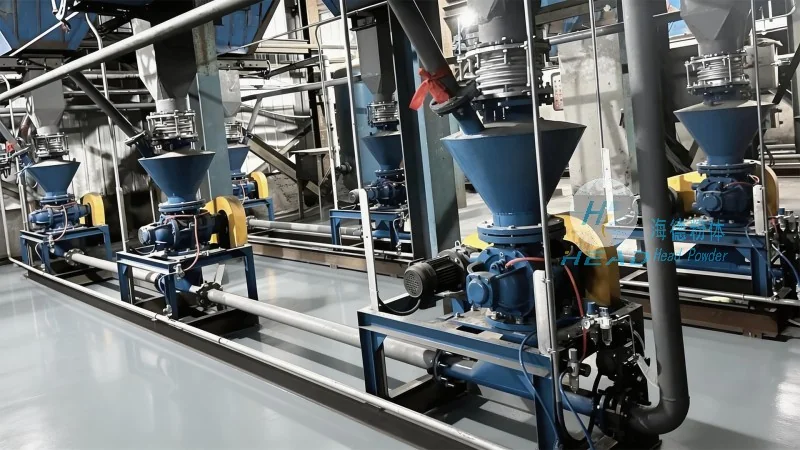
Applications of Plaster Powder Pneumatic Conveying
Pneumatic conveying systems for plaster powder find wide applications across various industries. In the construction industry, these systems are used to transport plaster powder from storage silos to mixing plants or to different work sites. This ensures that the powder is delivered in a clean and dry state, which is essential for maintaining the quality of the final plaster products. In the interior decoration sector, pneumatic conveying is used to transport plaster powder to mixing stations or to spray booths, where it is mixed with other materials to create decorative finishes. The technology is also used in the manufacturing of plaster products, such as gypsum boards, where the powder needs to be conveyed from raw material storage to the production lines. Additionally, in the agricultural and horticultural industries, pneumatic conveying systems are used to transport plaster powder for pest control or soil amendment purposes. The versatility of pneumatic conveying makes it an ideal solution for various applications, as it can handle different types of plaster powder and adapt to different operational requirements.
Advantages of Using Pneumatic Conveying for Plaster Powder
Compared to traditional methods of transporting plaster powder, such as manual handling or mechanical conveyors, pneumatic conveying offers several advantages. One of the most significant benefits is the ability to transport the powder in a dust-free environment, which improves product quality and reduces the risk of contamination. This is particularly important for plaster powder, which is often used in applications where purity is critical, such as in the production of high-quality gypsum boards or decorative plaster. Another advantage is the improved operational efficiency, as pneumatic conveying systems can handle large volumes of material at high speeds, reducing the time and labor required for transportation. Additionally, the systems are relatively compact and can be easily integrated into existing production lines, making them a cost-effective solution for many businesses. The technology also offers better control over the flow rate and pressure, which allows for more precise control over the material transport process. This can lead to better product consistency and reduced waste.




