In the industrial material handling field, a limestone pneumatic conveyor is an efficient and flexible conveying device widely used for transporting limestone and other granular materials. This article delves into the definition, core design principles, and practical advantages of limestone pneumatic conveyors in industrial applications.
What is a Limestone Pneumatic Conveyor?
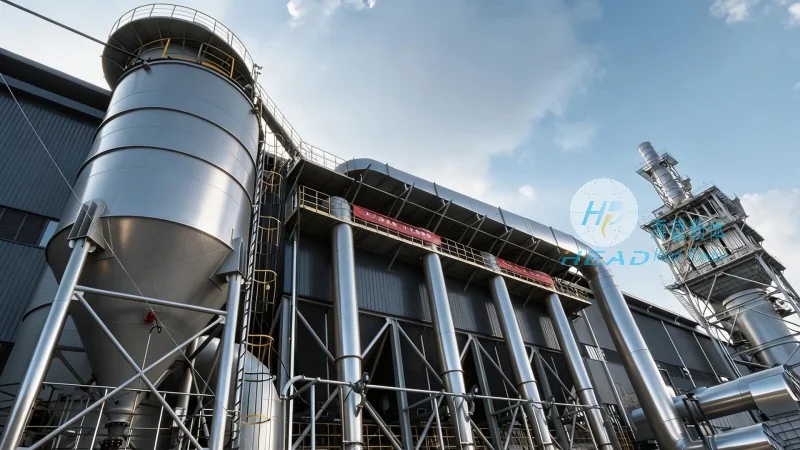
A limestone pneumatic conveyor is a device that uses gas (typically compressed air or inert gas) as a power source to transport solid granular materials like limestone through a pipeline system from one location to another. Compared to traditional mechanical conveying equipment (such as belt conveyors or screw conveyors), pneumatic conveyors offer advantages like no mechanical contact, long-distance transport capability, adaptability to complex paths, and the ability to handle fragile or sensitive materials. This equipment typically consists of feeding devices, conveying pipelines, air source systems, separators, and control devices, enabling continuous and stable material transport.
Design Principles of a Limestone Pneumatic Conveyor
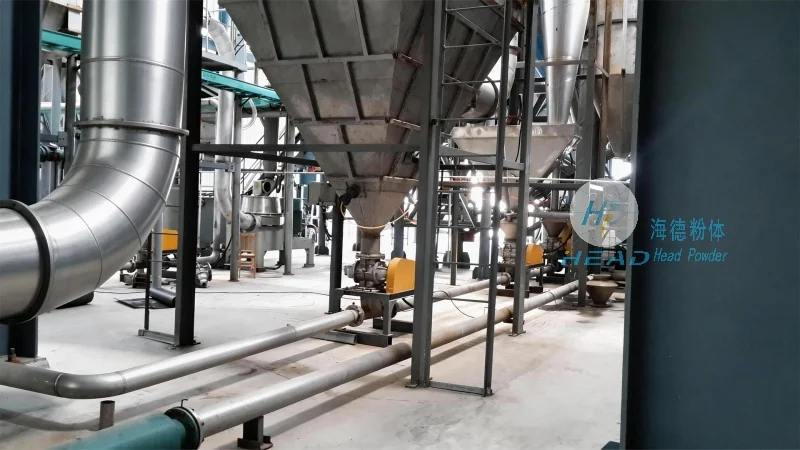
The design principles of a limestone pneumatic conveyor are primarily based on fluid mechanics and particle transport theory. The core is to suspend limestone particles in a high-speed gas stream to form a gas-solid two-phase flow for material transport. Key aspects to consider in the design process include:
- Airflow Velocity and Particle Suspension: The conveying airflow velocity must be high enough to overcome particle gravity and keep them suspended. Typically, the airflow velocity needs to be 1.5 to 2 times the particle terminal velocity to prevent deposition in the pipeline. For limestone particles, their density and size affect the terminal velocity, so design calculations must be based on the specific material properties.
- Pipeline System Design: Pipeline diameter, length, and bend angles all impact transport efficiency and energy consumption. Wider pipes reduce airflow velocity and energy consumption but increase equipment cost and footprint. Bend design must consider airflow direction changes to avoid particle deposition or impact at bends. Large-radius bends are commonly used, and flow guides or buffer devices may be installed to reduce particle impact and wear.
- Air Source System and Pressure Control: The air source system typically includes air compressors, storage tanks, filters, and pressure regulators. Compressed air pressure and flow rate must be selected based on transport distance, pipeline resistance, and material characteristics. Excessive pressure increases energy consumption and equipment wear, while insufficient pressure may fail to maintain particle suspension. Precise pressure control is required, often using constant or adjustable pressure systems to accommodate different transport needs.
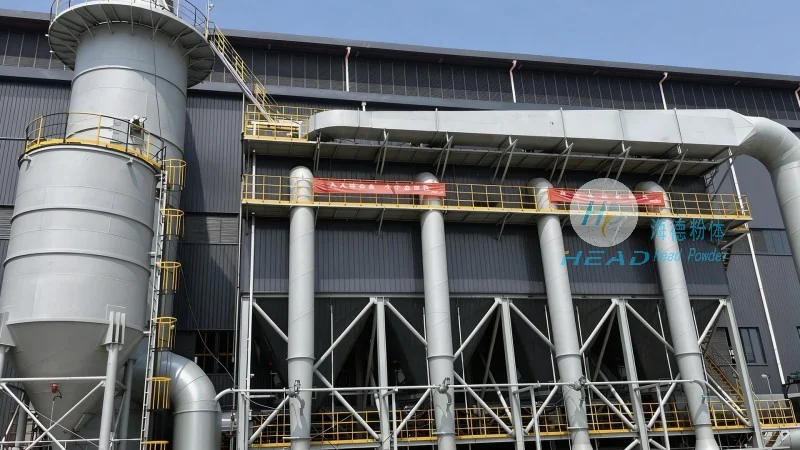
- Separation and Collection Devices: At the transport endpoint, a separator is needed to separate material from the airflow and collect it. Common separation methods include gravity settling, cyclone separation, or baghouse filtration. The separated airflow is usually treated for purification to recover fine powders or prevent environmental pollution. The collection device design must consider material flowability to avoid caking or blockage, often using hoppers, vibrators, or screw conveyors as auxiliary equipment.
HeadPowder Company and Its Limestone Pneumatic Conveyor Solutions
Shandong HeadPowder Engineering Co., Ltd. (referred to as HeadPowder) is a professional company specializing in R&D, manufacturing, and service of powder engineering equipment, headquartered in Shandong, China. HeadPowder is committed to providing efficient and reliable limestone pneumatic conveyor solutions to meet material transport needs in various industrial scenarios. The company leverages years of industry experience and technological accumulation, with rich expertise in equipment design, manufacturing processes, and control systems, to customize limestone pneumatic conveyors according to customer requirements, ensuring efficient operation and long-term stability.
Application Scenarios and Advantages
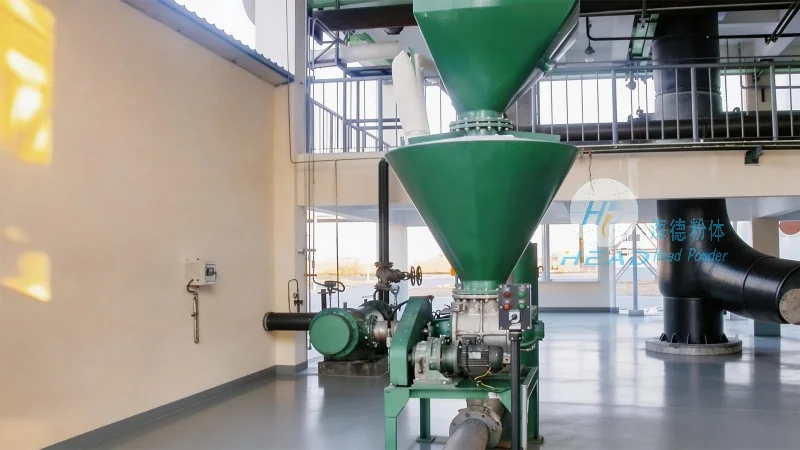
Limestone pneumatic conveyors are widely applied in industries such as cement, lime, chemical, metallurgy, and food. For example, in cement production, limestone as a main raw material needs to be transported from mines to production workshops, and pneumatic conveyors can achieve long-distance, dust-free transport; in the chemical field, limestone is used to produce calcium hydroxide or calcium carbonate, with pneumatic conveyors efficiently transporting raw materials and products; in the metallurgical industry, limestone as a flux needs to be precisely transported to blast furnaces or converters, with pneumatic conveyors ensuring accurate and stable transport. Compared to traditional mechanical conveying methods, HeadPowder's limestone pneumatic conveyors have the following advantages:




